Job Hunt Support Series #2 - Profile Development, Part 1

Updated: Sep 14
Long gone are the days when a resumé alone could get you a job. Nowadays, it's important to create an online microcosm that works as an introduction to who you are and what you're about. In this installment of the Job Hunt Support series, we'll start with the resumé and portfolio, then work our way up to developing a profile that does the talking for you while you are job seeking.
Missed the previous post on Mindset? Start, here.
The Resumé is Not What it Used to Be
I resonate so much with a recent post I read on LinkedIn from someone who was tired of creating boring resumés. I also miss the time when personality could be embued in one's resumé without it messing with your chances of getting through to the interview phase, but alas we are now well into the era of ATS and keyword parsers. Where did all the fun go?
The resumé has become a piece of content that serves as a key to unlock an invisible door. It's no longer the sole container for everything you are as a professional and it's important to realize that, make peace with it and treat it as such.
The work that goes into resumés these days is more a task of content writing and design and less of a visual design one. The latter is now almost none-existent or minimal. A few dividers here and there. A tiny icon with your email next to it. That's it.
So, how do I write a good resumé in 2026?
Let's start with the basics. Before you tweak that resumé from 2 years ago, extract the real value from it and build from there.
Skills Inventory
Make a list of every single skill you have acquired through your professional experience. Clasify them in both soft and technical. Everything counts. Skills are not roles you've held in an organization, they are actual capabilities you've developed during your tenure there.
If you were a visual designer for two years and your manager asked you to prepare workshops for interns and junior designers, then you have experience designing training programs. Put that on the list.
If your marketing team has great strategies but resorts to you to create collateral for every event they organize then, you have skills in marketing visual design. Put that on the list as well.
Keyword Research
Take a few minutes to browse around company career portals, job postings and identify repeated instances of keywords. What skills do these positions have in common? What is the average experience they require? What business vocabulary should I be familiar with? Do they name specific tools or frameworks?
These keywords should be a part of your resumé, either listed as skills or better yet, in the context of your job experiences. Keyword parsers nowadays take these context clues into account to assess the relevance of these skills.
Note: Take a look at the tools mentioned. Are they design software? CRMs? CMS? If there's a name you do not recognize, do a quick online search. Software of any kind has core functionalities which they share with other software that is designed for the same purpose. Check a quick tutorial and add it to your skills. It's likely you'll be able to master it in the time you spend waiting for a recruiter to get back to you.
Finally, make sure to include both acronyms and the full terms they represent. This is to make sure you have all your bases covered with both recruiters and keyword parsers looking for either of the two.
Storytelling, resumé style
Start with a short bio. This is not a cover letter. This is just a short introduction to yourself and it's your first opportunity to start providing context and some heavy-hitters from your keyword research. Address your professional history briefly and focus more on your goals and vision for your career path; also a great opportunity to align with some of the vision and goals of the company you're applying to.
Spend some time tinkering with how you describe each experience in your career. It's easy to sometimes forget some of the things you did during your time there. You can also ask a former coworker you trust to review it and help you fill in the gaps.
Use a combination of a short two or three-sentence description of your role and a concise set of bullet points that cover specific tasks, skills and achievements during that time. Don't be afraid to include metrics that relate to your involvement in projects or initiatives within the company. These help make your impact more tangible.
Weave some of those keywords into these text modules. It'll offer that additional skills context we're looking fore.
Start Building
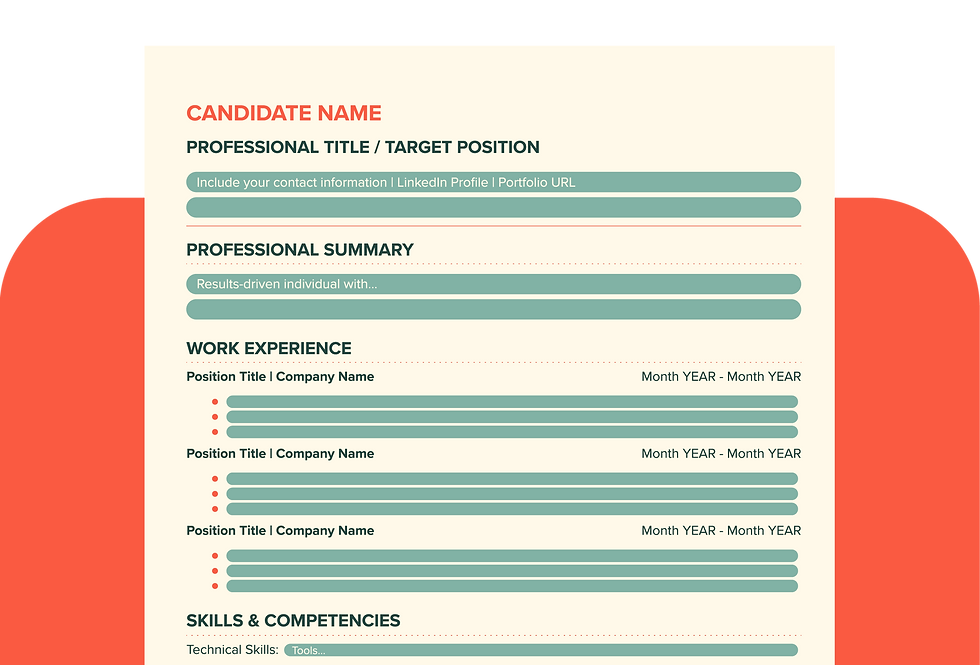
Start putting together your resumé. Prioritize your content layout based on how the job description prioritizes skills and requirements. For junior and mid-level positions, the usual one pager still applies but for more senior positions, having a second page is acceptable.
Keep your overall layout simple, preferably a single-column approach as to not confuse the machine reading through your stuff.
Try this experiment: I have a mental list (which also lives in the Illustrator file I have my resumé in) of things I want to try the next time I find myself back on the job hunt. One of them is creating a highlight section where I front load the most relevant experience for a particular job opening and disregard the standard chronological order. I would still include the years I worked there but not organize my experience solely based on that. Do it with a low-stakes resumé and report back. I'd love to hear how it went!
Be Mindful when Using AI
I know a lot of people will use AI during this process and honestly, I won't shame you for it. I personally think it's the tool of the trade now (or weapon of choice, whatever you want to call it) and we who are dependent on employment are somewhat forced to deploy these tools in order to level the playing field.
That being said, I do advise caution. Some models are known for sounding stuffy right off the bat. Others could produce much more compelling outputs, but a thorough review is still required. The key here is the practice of telling your professional story for when the interviews come. Writing and proof-reading your resumé can help you establish the foundation of how to do it.
Use it for research, to extract keywords from a lengthy job description, but make sure you write and proofread your own resum[e. This will allow you to start setting the mental model of how to elaborate on your professional experience.
Your Starter Kit - Tool #2 - FREE DOWNLOAD
Use this Visual Blueprint to determine your resumé's layout. I've created both a one and two-pager formats. Use the one that aligns with your experience and target positions.
But wait! There's more!
I've decided to make this installment a three-parter. There's still a lot to cover and I want to be considerate with yall's attention span. In parts two and three, we'll dive into the portfolio and professional website, when to leverage each one or combine the two.


Comments